LibreFang
The Agent Operating System for running autonomous AI agents 24/7 in Rust.
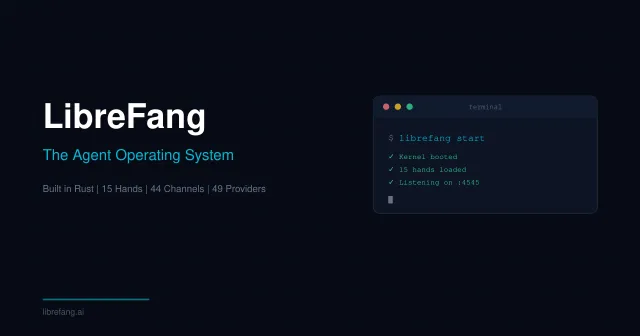
About
LibreFang is an autonomous AI agents platform for running production workloads around the clock. It is a production-grade runtime built in Rust, designed as an agent operating system with a single-binary setup, built-in capability units, and dozens of channel adapters.
What is LibreFang
LibreFang is an autonomous AI agents platform that positions itself as an agent operating system for production use. It is built in Rust and described as a single-binary runtime for workloads that “can’t afford to go down.” The project says it supports 24/7 operation, and its site highlights a versioned open-source release line.
The app is not presented as a chat UI or a simple wrapper around a model. Instead, LibreFang focuses on orchestration: it runs autonomous AI agents, connects them to tools and channels, and provides a system for managing workflows end to end. The homepage also shows runtime status, including “4 agents running” and “38MB,” which suggests a lightweight local or deployed runtime footprint.
Key features
LibreFang’s autonomous AI agents setup is built around several concrete pieces:
- Single-binary runtime: the site emphasizes one command and no Docker requirement for getting started.
- Built in Rust: the stack is presented as Rust-first, with a focus on production workloads rather than prototypes.
- Built-in capability units: the product mentions 15 built-in Hands, each with its own model, tools, and workflow.
- 44 channel adapters: the runtime can connect agents to many output or integration channels.
- Five-layer architecture: each layer is isolated, testable, and replaceable, from hardware through user-facing channels.
- Workflow automation: sample workflows include content pipelines, sales prospecting, competitive intelligence, multi-agent orchestration, and migration.
- Security controls: the site lists a WASM sandbox, Merkle audit chain, SSRF protection, prompt injection scanning, and GCRA rate limiting among its security layers.
- Skill self-evolution: after complex tasks, a background LLM review can decide whether an approach should be saved as a new skill.
- Hot reload: updated skills can become available immediately without restarting the daemon.
- Version history: skills can keep up to 10 versions with timestamps, changelogs, and rollback snapshots.
For people comparing autonomous AI agents tools, the combination of Rust, security scanning, and deployment-oriented features is the main differentiator.
How to use it
Using LibreFang follows the pattern of an autonomous AI agents runtime rather than a consumer app. The site gives a few clear entry points:
- Get the runtime from the downloads area, which offers a desktop app and CLI binaries.
- Start with one command using the project’s quick-start flow; the site says you can reach autonomous agents in about 60 seconds.
- Choose a Hand or workflow from the registry and capability units instead of assembling everything manually.
- Connect channels so the autonomous AI agents can publish, alert, or export results across supported adapters.
- Use documentation for architecture, automation, and infrastructure topics such as monitoring and scaling.
The product also advertises a migration path with librefang migrate --from openclaw, which suggests the CLI is central to setup and portability.
Who it is for
LibreFang is aimed at teams that want autonomous AI agents for operational work, not just experimentation. It looks most relevant for:
- engineering teams building production automation
- operators who need long-running agent workflows
- startups replacing manual research or content ops with autonomous AI agents
- developers who prefer Rust-based infrastructure
- teams that care about auditing, sandboxing, and rollback controls
The example workflows make the intended audience clearer. Content pipeline automation, sales prospecting, competitive intelligence, and migration all point to business processes that benefit from repeated execution, logging, and channel delivery.
What to know before you use it
LibreFang is ambitious, but there are important limits and caveats to keep in mind.
- It is not a general-purpose chatbot; it is built around autonomous AI agents and workflow execution.
- The product claims production features, but you should still validate the autonomous AI agents on a small, low-risk workflow before trusting them with customer-facing operations.
- Security features such as prompt injection scanning and SSRF protection are helpful, but they do not guarantee safety in every environment.
- The site lists multiple adapters and built-in Hands, yet the exact coverage for your stack may depend on the registry and documentation.
- The “self-evolution” feature can save new skills automatically, so teams should review what gets persisted before relying on it broadly.
- For compliance, billing, or source-of-truth data, use official systems instead of assuming the agent output is authoritative.
If you need autonomous AI agents that run continuously, LibreFang is positioned as a production runtime with strong operational controls. For anything sensitive, treat it as an automation layer that still needs human review, testing, and domain-specific safeguards before full rollout.
FAQ
What does LibreFang actually do?
LibreFang runs autonomous AI agents as a production runtime. The site positions it as an agent operating system with built-in capability units, workflow automation, and multi-channel delivery.
Is LibreFang free to use?
It appears to be open source. The site explicitly labels a release as open source, but it does not show a full pricing page or paid plan details in the harvested material.
What platforms does LibreFang support?
LibreFang offers a desktop app and CLI binaries. The site also presents documentation and deployment options, but no mobile apps are mentioned.
Does LibreFang require Docker?
No, the site says you can get started with one command and explicitly notes that Docker is not required for the initial setup path. It also describes a single-binary runtime.
How is LibreFang different from a chatbot tool?
LibreFang is built as an autonomous AI agents runtime, not a simple chat interface. It focuses on workflows, channel adapters, security scanning, and long-running operation.
Can LibreFang handle production workloads?
That is the product’s stated goal. The site describes it as production-grade, built in Rust, and designed for workloads that cannot afford downtime.
Who is LibreFang best suited for?
It is best suited for teams building or operating agent-based automation in production. The examples focus on content pipelines, sales prospecting, competitive intelligence, and multi-agent orchestration.
Who should try LibreFang first?
Developers and operations teams should try it first. It is aimed at people building automation for content, sales, research, and other repeatable workflows.